


The difference between boosting a post and running a Meta ad is how much control you get over what happens with your money. Boosting takes something you have already put on Facebook or Instagram and pays to show it to more people. Running a Meta ad means building the campaign properly in Ads Manager, where you decide what you actually want out of it, who sees it, where it appears and what it says. Both are paid adverts on the same platform, and both spend your budget. One is a shortcut, the other is a proper piece of advertising.
It is the question we get asked more than almost any other, usually by a business owner who has been boosting posts for months, watched the reach climb and noticed the enquiries have not. Once you understand what each one is actually asking Meta to go and do on your behalf, that starts to make a lot more sense.
What Boosting a Post Actually Does.
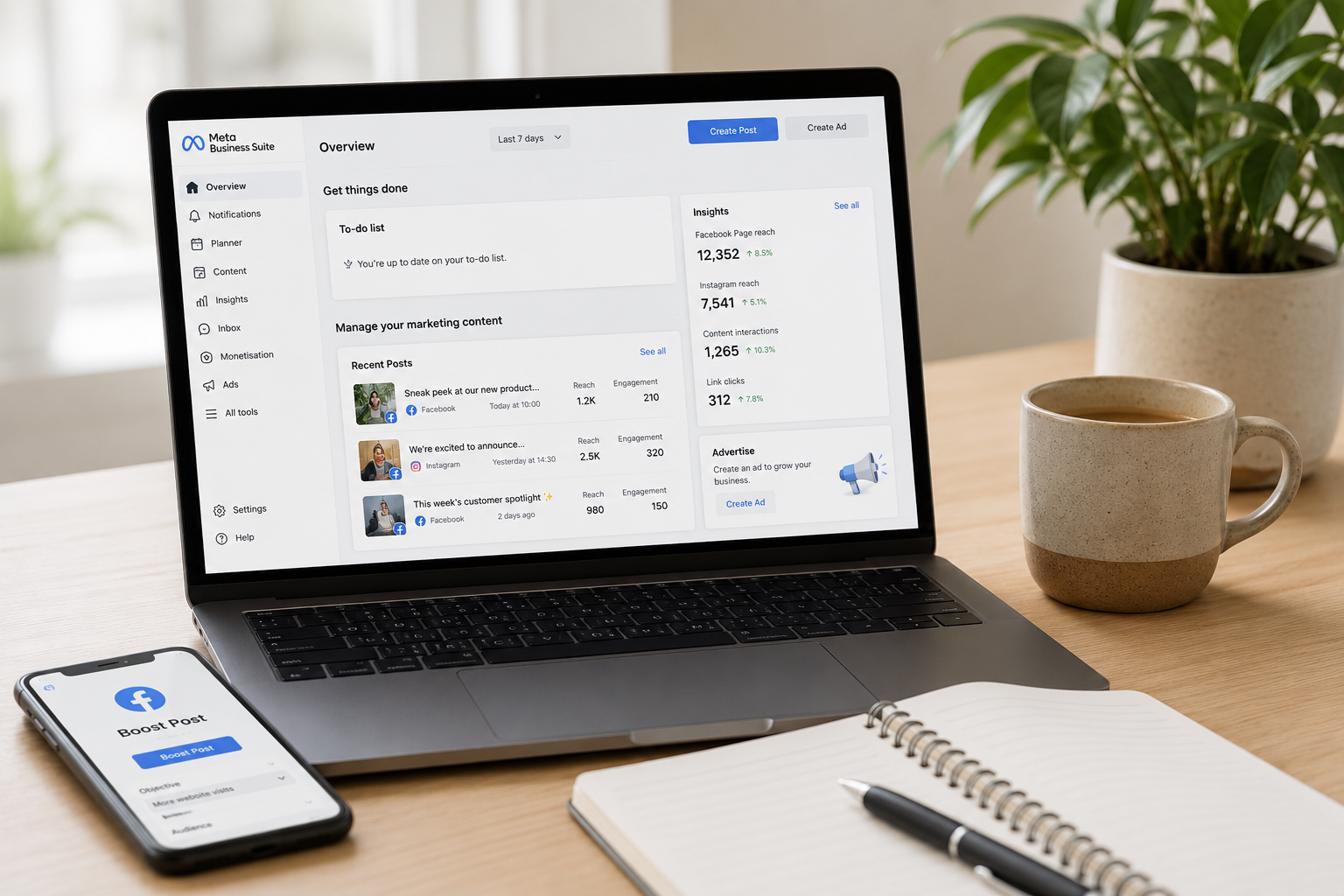
Boosting starts from the button sat underneath your own post. You pick a goal, a budget, a rough audience and how long you want it to run, and Meta shows that post to more people than it would have reached on its own. It takes about two minutes and you never have to leave the app.
The goals you get to pick from are a short menu, and the exact list depends on the post, the platform and your account. When you boost a post from your Facebook Page it usually runs along the lines of more engagement, more website visitors, more messages, more calls, more page likes, or an automatic option that decides for you. Boosting has crept into lead generation as well, so you will often see a leads goal that collects details through a form on Meta’s own platform. Instagram’s menu is narrower again.
What you cannot do is point a boost at something that happens on your own website. There is no conversion event to choose, so you can ask Meta to send people to your site, but you cannot ask it to go and find the people who will actually fill in the form once they get there. It optimises for the click, not for what happens after it.
So Meta does exactly what you asked it to. Ask for engagement, which is where most boosts land unless you actively choose otherwise, and it goes looking for the people most likely to like, comment and share. Those people are not always the same people who are ready to spend money with you.
Boosting optimises for the thing you asked for. If you asked for engagement, engagement is what you will get.
Not getting enough enquiries?
Book a free audit and we’ll spend 30 minutes going through your website, telling you exactly what’s holding it back and what we’d do to fix it.
Book your free audit
What our clients have to say.
Real feedback from satisfied customers who’ve experienced first-hand how our solutions have made a difference.
Sokada are great
Sokada are great – Jude and Julian are lovely people and are experts in the field. I have no issue I recommending them to anyone that needs website help.
 Andy Price Founder of Initial IT
I am excited for the future with Sokada onboard.
Julian & Jude have been incredible in helping me with my online marketing. I have seen an increase in local business from using their local SEO services and PPC. It has been an incredible return on investment and I am excited for the future with Sokada onboard. Thank you!
What Running a Meta Ad Actually Means.
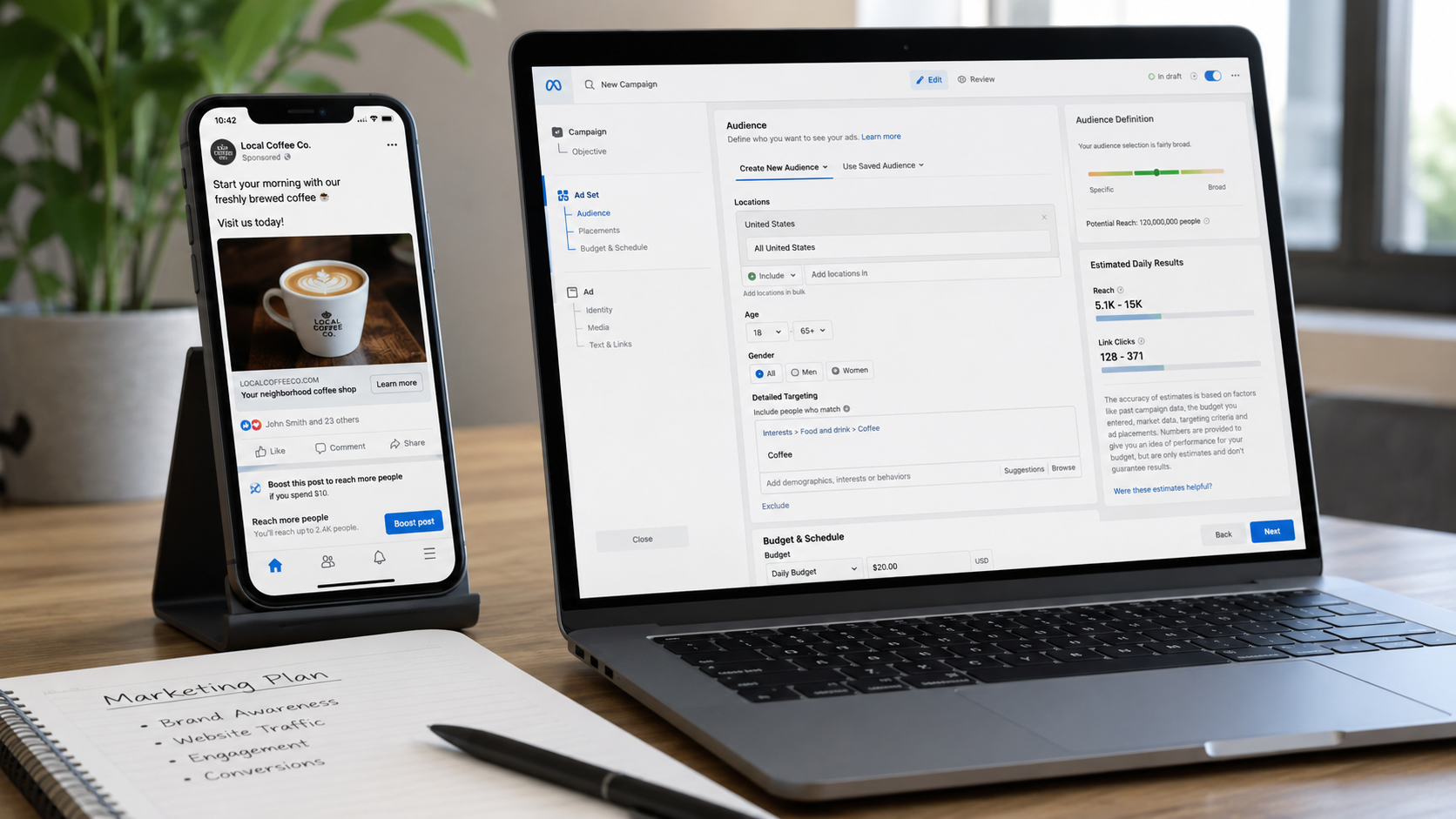
A proper Meta ad is built in Meta Ads Manager, which is the same tool agencies use to run six-figure budgets. It is structured in three layers. The campaign holds the objective, the ad set holds the audience, the schedule and the placements, and the ad holds the actual image, video and words. Your budget can sit at either of the top two levels, and Meta now tends to default to one campaign budget that it shares out across your ad sets, though you can still set them individually if you want the control.
At campaign level you pick from six objectives: awareness, traffic, engagement, leads, app promotion and sales. Several of those now overlap with what boosting can do, at least by name, and it is worth being honest about that rather than pretending boosting is useless. Sales is the clearest thing it cannot touch, because there is no way to optimise a boost for a purchase. And where the names do match, the version in Ads Manager comes with the audience control, the placement control and the tracking that the boosted version simply does not have.
You can also start an ad from a post you have already published, so you are not throwing away content that has done well organically. You just get to point it at a sensible goal instead of a vague one.
The Difference Between Boosting a Post and Running a Meta Ad, In Practice.
Stripped back, there are four things that separate them, and every one of them affects whether you get work out of the money you spend.
The first is the goal. Boosting lets you buy attention. Ads Manager lets you buy an outcome. Meta will optimise hard for whichever one you choose, so the choice matters far more than most people realise.
The second is the audience. Boosting gives you the basics: location, age, gender, a handful of interests, or an automatic audience Meta picks for you. Ads Manager gives you custom audiences built from your customer list, people who have visited your website, people who have watched your videos or engaged with your page and Instagram account, and lookalike audiences built from any of those. You can also exclude an audience, which matters if you do not want to keep paying to reach customers who have already bought. One thing to know is that Meta scrapped detailed targeting exclusions in 2025, so excluding people now works off audiences rather than off interests and behaviours.
The third is where your ad appears, and this is the one most people have backwards. A boost is not stuck in the feed. It runs across feeds, Stories, Reels and more, because it uses automatic placements. What you do not get is any say in it. Switch to manual placements in Ads Manager and you can pick from the full list, which includes Reels, Stories, Marketplace, Messenger, Threads, search results and the Audience Network, and turn off the ones wasting your money. Do check the setting that lets Meta keep spending a small slice of budget on the placements you excluded, because otherwise they are not really off.
The fourth is what you can measure. Boost reporting covers the basics well enough: reach, engagement, clicks, spend and cost per result. What it will not tell you is what happened on your website afterwards. A campaign wired up to your Meta Pixel, which Meta now files under datasets but everyone still calls the pixel, reports the enquiries and the sales themselves and what each one cost. Meta also recommends running the Conversions API alongside it, because browser privacy settings and ad blockers mean a pixel-only setup quietly loses events and makes your results look worse than they really were.
Not getting enough enquiries?
Book a free audit and we’ll spend 30 minutes going through your website, telling you exactly what’s holding it back and what we’d do to fix it.
Book your free auditCase studies.
Behind every one of these is a business owner who was frustrated, not getting enough enquiries, and needed someone to actually sort it. We’re proud of every single one.
Black Label Grading
Why Boosted Posts Get Likes But Not Enquiries.
This is the pattern we see most, and it is where the difference between boosting a post and running a Meta ad stops being a technicality and starts costing real money. A boosted post does numbers. Reach in the thousands, a decent pile of reactions, a few shares. The business owner reasonably assumes something is working. Then the month ends and the diary looks the same as it always did.
Nothing has gone wrong. Meta was told to find engagement and it went and found engagement. The system predicts who is most likely to do the exact thing you asked for, so an engagement goal goes looking for habitual likers and commenters rather than people who are about to buy something. Name the wrong action and you get a cheap result that does nothing for the business. We have written before about why likes on social media do not matter as much as they feel like they should, and boosted posts are where that gap shows up most clearly.
The other half of the problem is usually the destination. If a boosted post sends people to a homepage that does not say what you do or make it obvious how to get in touch, the traffic has nowhere to go. Paid traffic exposes a weak website design faster than anything else, because you are paying for every visitor who bounces.
When Boosting a Post Is Genuinely Worth It.
We are not against boosting. It has a job, it is just a small one.
Boosting makes sense when a post is already doing well organically and you want more of the same people to see it. It works for an event you want local people to know about, a recruitment post, a new premises, an award, or anything where being seen is the whole point. It is also a cheap way to test whether a message lands before you spend real money building a campaign around it.
For anything local, boosting a genuinely good post to a tight radius around your town can be a sensible little top-up alongside your other localised marketing. What it should not be is your entire paid strategy.
Boost to be seen. Build a campaign to be bought from.

Not getting enough enquiries?
Book a free audit and we’ll spend 30 minutes going through your website, telling you exactly what’s holding it back and what we’d do to fix it.
Book your free auditWhy the Ad Itself Now Matters More Than the Settings.
One thing worth knowing before you spend anything is how much Meta now does on its own. Its systems have got considerably better at working out who should see which advert, which is what the Meta Andromeda update was largely about.
The practical effect is that endlessly narrowing your audience does less than it used to, while the advert itself does more. A clear message, a visual that shows the thing you actually sell, and two or three variations rather than one, will usually beat another hour of fiddling with interest targeting.
That does not make Ads Manager less important. It makes it more important, because the objective you choose is now the strongest instruction you give Meta. Choosing “leads” instead of “engagement” changes who Meta goes looking for from the first pound you spend, and that is a lever boosting simply does not hand you.
How to Decide Which One You Need.
The honest test is to ask what you want back for your money, because the difference between boosting a post and running a Meta ad is really the difference between buying attention and buying an outcome.
If the answer is that you want more people to see something, boosting is fine and the two minutes it takes is part of its appeal. If the answer is that you want the phone to ring, a form filled in, a booking made or a product sold, you want a campaign in Ads Manager with the right objective, an audience worth reaching and tracking that tells you what it cost.
Most small businesses we work with end up doing both, with the split heavily weighted towards proper campaigns. The boosting sits on top for visibility, and the paid marketing underneath it does the actual selling. Your organic social media keeps the whole thing warm.
Not getting enough enquiries?
Book a free audit and we’ll spend 30 minutes going through your website, telling you exactly what’s holding it back and what we’d do to fix it.
Book your free auditFAQs.
Yes, for the right job. Boosting is a reasonable way to get more eyes on a post that is already performing, promote an event, support a recruitment drive or test whether a message lands before you invest in a full campaign. It is a much weaker way to generate enquiries, and it cannot optimise for a sale at all, so it should not be the thing carrying your lead generation on its own.
Because that is probably what you asked for. Boosts land on engagement unless you actively pick something else, so Meta goes and finds the people most likely to react to your post rather than the people most likely to become customers. If you want enquiries, you need a campaign in Ads Manager set to a leads or sales objective, pointed at a page built to convert.
Yes. In Ads Manager you can use an existing Facebook or Instagram post as the creative inside a campaign, so you keep the engagement it has already built up while pointing it at a proper objective with better targeting and tracking. It is usually a far better use of a good post than boosting it.
They do different jobs. Meta ads mostly interrupt people who are not looking for you yet, which is why the advert itself has to earn the attention. Search ads catch people who are already looking. Meta does now sell ad space in Facebook and Instagram search results, so the line is blurrier than it was, but the bulk of Meta spend still goes to feeds and Reels. Plenty of businesses benefit from both, though if budget is tight it is worth working out which stage of the buying process you most need help with first.
Boosting a Post or Running a Meta Ad: Which Should You Do.
It is not really a question of which one is better, it is a question of which one matches what you need. Boosting buys attention quickly and cheaply. A campaign in Ads Manager buys outcomes you can actually count. The trouble starts when a business uses the first one and expects the results of the second.
If you have been boosting posts for a while and cannot point to a single enquiry that came from it, that is worth looking at properly rather than spending another month hoping. Our case studies show what joined-up marketing looks like when the website and the advertising are pulling in the same direction.
Understanding the difference between boosting a post and running a Meta ad is usually one of the quickest wins we find in a small business’s marketing. We are Sokada, a family-run web design and marketing agency in Heathfield, East Sussex, and getting small businesses more enquiries is the whole point of what we do. If you would like someone to look at what you are running and tell you honestly whether it is working, book a free audit or get in touch and we will talk it through.
Not getting enough enquiries?
Book a free audit and we’ll spend 30 minutes going through your website, telling you exactly what’s holding it back and what we’d do to fix it.